Featured Product
Gamakatsu EWG Hook Size 4
Extra Wide Gap fishing hooks in size 4, used for steelhead fishing
"these are called Gamakatsu and there are number four or number six ewg"
Spring Steel and Brown Gold: A Complete Guide to Chasing Steelhead and Brown Trout
There's a particular kind of electricity that runs through a river angler in spring. The ice is off, the tributaries are running cold and clear, and somewhere beneath the surface, chrome-bright steelhead and heavy-shouldered brown trout are pushing upstream. For Great Lakes anglers, it's the season they've been waiting for all winter — and for those just getting started, it can feel overwhelming. Where do you begin?
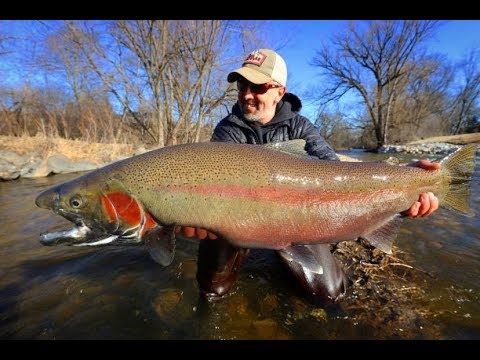
Eric Haataja, a former fishing guide who spent his formative years working the Root River in Racine, Wisconsin, has been helping anglers answer that question for years. In a recent how-to video filmed across several spring fishing sessions, Eric broke down his approach to steelhead and brown trout fishing into a handful of accessible, proven techniques — and the results speak for themselves. Multiple fish landed, unforgettable encounters with fish on beds, and one heart-stopping battle with what he estimates was a twelve-pound steelhead in a tiny tributary creek.
Whether you're picking up a spinning rod for the first time or looking to add new tools to your Great Lakes arsenal, Eric's methods offer a solid, practical foundation. Here's everything you need to know.
Understanding the Fishery: Great Lakes Browns and Steelhead
Before diving into technique, it helps to understand what you're targeting and why the Great Lakes region offers such a remarkable fishery. Steelhead — sea-run rainbow trout adapted to lake-run life — pour into tributary streams each spring and fall, staging for their spawning runs. Brown trout do the same in fall, though spring often delivers a mixed bag of both species in the same water.
Eric is unabashedly enthusiastic about what his home region offers.
"We are so spoiled here with our Great Lakes browns and steelhead — one of the best fisheries in the world," he says, watching a spawned-out brown drift back into the current after a successful release. "You get a mix of browns and steelhead, and when they're in, they're in."
The Root River, where much of his footage was filmed, is a highly pressured public fishery in southeastern Wisconsin — not the kind of secret spot that stays secret for long. Yet even on a Monday afternoon, Eric is landing fish. The lesson isn't about finding untouched water; it's about understanding fish behavior and presenting the right bait in the right way, regardless of how many other anglers are nearby.
One important note on natural reproduction: Eric addresses the sometimes contentious topic of fishing to fish on spawning beds directly. He's careful to distinguish between hatchery-stocked fish, which make up the vast majority of the southern Wisconsin and Lake Michigan tributary fishery, and wild fish with robust natural reproduction, which deserve a wider berth. In waters with poor water quality and minimal natural recruitment, fishing pressure on spawning fish is far less of a conservation concern — though he's clear that ethical presentation matters. No lining, no foul-hooking, no force-feeding reluctant fish.
Mentioned in This Article
Gamakatsu EWG Hook Size 6
Extra Wide Gap fishing hooks in size 6, used for steelhead fishing
The Three Core Techniques: An Overview
Eric organizes his spring steelhead and brown trout approach around three primary methods, each suited to different conditions and levels of experience. Together, they cover nearly every scenario you'll encounter on a tributary river in spring.
These are: fishing with spawn sacks, fishing with beads, and using tube jigs tipped with wax worms. Underpinning all three is a fourth element that Eric returns to repeatedly — hand-tied inline spinners, which he argues are among the most versatile and effective lures in the Great Lakes angler's toolkit.
Understanding when and how to deploy each method, and how to read the water to make that decision, is what separates casual weekend anglers from those who consistently put fish in the net.
Method One: Spawn Sacks — The Gold Standard
If you ask a veteran Great Lakes angler what single bait they'd choose for steelhead, the answer is almost always the same: spawn. Egg clusters, tied into small mesh sacks and drifted beneath a float or bounced along the bottom, are the most time-tested and consistently productive presentation in the tributary fishery.
Spawn sacks work because steelhead and brown trout are conditioned by evolution to seek out and consume loose eggs drifting in the current — both the eggs of other fish and, during spawning season, the dislodged eggs from nearby redds. A well-tied spawn bag presented naturally in the current column is nearly irresistible.
The catch, as Eric explains, is access. "These are actual eggs that are frozen in a bag — they'll unthaw and you can tie these in the spawn sacks," he says, showing a bag of salmon or trout eggs to the camera. "But not everybody can get spawn. You have to catch a fish and get the eggs out of the fish to have them."
That's a real barrier for new anglers. Spawn is typically obtained by harvesting eggs from a hen fish, treating them with a curing agent like borax or Pro-Cure, and freezing them for future use. If you haven't been catching fish — or don't know anyone who has — spawn can be hard to come by. Some bait shops in Great Lakes communities carry it seasonally, but supply is inconsistent.
The payoff when you do have good spawn, however, is hard to argue with. During one of Eric's sessions, fishing partner Adam cycles through a worm and then a bead with no results before tying on a spawn sack. First drift. Fish on. "Got to mix it up," Eric says, grinning. "Spawn sack — deadly."
Mentioned in This Article
Lamiglas Redline Float Rod
Float fishing rod used for steelhead fishing on Great Lakes tributaries
Method Two: Beads — Egg Imitations That Deliver
For anglers who can't source real spawn, beads offer an excellent and widely available alternative. Small plastic or glass spheres sized to mimic individual fish eggs, beads have become a standard tool in the Great Lakes tributary fishery — borrowed in large part from Alaska's salmon and steelhead culture, where the technique was pioneered decades ago.
The rigging is simple: a bead is pegged onto the mainline roughly one to two inches above a single hook, allowing the bead to float naturally in the current just ahead of the hook point. "You put them up on your line, you peg it about an inch or two above the hook, and you fish it under a bobber," Eric explains. "Beads work really, really good."
Color selection matters. Pink, orange, and peach tones — mimicking the natural color of salmon and trout eggs — are the go-to choices, though the specific shade that produces best can vary by water color and light conditions. Eric carries a well-stocked bead box to cover his bases.
Where beads truly shine, and where Eric's most dramatic footage unfolds, is in sight fishing to fish on spawning beds. When steelhead or browns move up onto shallow gravel redds in clear spring conditions, a bead fished without a float — just a small split shot for casting weight — can be deadly. You can watch the fish react, track the bead as it drifts past, and sometimes see the moment of the take with your own eyes.
"She wants it — look at her chasing it," Eric narrates in an excited whisper, crouched behind a riverside tree to stay out of sight of a hen steelhead holding over a redd. "She's gonna eat it. Do it."
When she does eat, the hookset is clean and the fight is on. Eric lifts the fish briefly for the camera, pointing out the bead positioned precisely in the corner of the fish's mouth — a clean, ethical take that he emphasizes is categorically different from snagging. The fish is revived and released within moments.
Method Three: Tube Jigs and Wax Worms — The Beginner's Best Friend
Of all the techniques Eric covers, this one may be the most underappreciated in the Midwest tributary scene — and the most accessible for new anglers. Small tube jigs, the same style commonly used for crappie and panfish, tipped with one or two wax worms and fished beneath a small float, are quietly lethal on both steelhead and brown trout.
"This is probably going to be the easiest thing for you guys," Eric tells a group of young anglers who had stopped by during his bait-making session. "You can get a whole bunch of different types, but usually white works really good, or pink and white. You just get a little jig head like you're crappie fishing, put a wax worm or two on it, and fish it under a float. That is deadly. Brown trout and steelhead love these little tubes big-time."
The beauty of this setup is its simplicity and low cost. Crappie tube jigs are available at virtually any sporting goods retailer, wax worms are a standard bait shop item, and the rigging requires no special skills. For a parent introducing a child to tributary fishing, or an angler transitioning from panfishing who wants to try something new, tubes under a float are an ideal entry point.
The technique is particularly effective in slower, deeper pool water where a float can be set to run the jig at the right depth through the strike zone. White and pink-and-white color combinations tend to draw the most attention, though chartreuse and natural shad colors can also produce depending on water conditions.
Mentioned in This Article
Daiwa Dial Well Reel
Spinning reel used for float fishing for steelhead
Building Your Own Inline Spinners: A Step-by-Step Approach
Beyond the three core bait techniques, Eric dedicates a significant portion of his video to a skill that he clearly loves: tying his own inline spinners by hand. It's a traditional craft that's experienced something of a revival among tributary anglers, and for good reason — a well-built spinner is one of the most effective year-round lures for aggressive steelhead and lake-run browns.
The components are straightforward and inexpensive: a wire shaft, beads, a clevis (the small bracket that holds the spinning blade), a weight, a blade, and a hook. Eric prefers Gamakatsu EWG hooks in size four or six — sharp, strong, and reliable. "That's really important," he emphasizes. "A good sharp hook."
The assembly process begins by threading a bead and clevis onto the wire, followed by the weight, and then two additional beads behind the weight. The hook is then attached to the wire with a careful wrap that leaves a small gap — crucial, Eric explains, because too-tight a connection will prevent the blade from spinning freely.
"If it's real tight it won't spin, so you have to have a little bit of a gap," he explains as he wraps the wire around the hook shank. "Wrap it all the way around — it doesn't have to be fancy. All you've got to do is get it wrapped around one time or three-quarters of a time."
Once the hook is secured, the blade snaps onto the clevis and the spinner is complete. The whole process takes just a few minutes once you've assembled your materials. Gold blades, in Eric's experience, are hard to beat as a starting point — they perform well in a wide range of water clarities and light conditions. From there, silver, copper, and painted blades give you options to dial in on different days.
The real advantage of tying your own spinners, beyond cost savings, is customization. By using an interchangeable clevis, you can swap different blade sizes and colors onto the same shaft, giving you flexibility without having to carry dozens of pre-built lures. It's a small detail that makes a meaningful difference when you're trying to figure out what fish want on any given day.
Reading the River: Movement, Pressure, and Fish Location
Technique is only half the equation. Knowing where to fish — and when to move — is what puts fish in your hands consistently. Eric's on-the-water footage offers a masterclass in the kind of mobile, adaptive approach that works on pressured public water.
His philosophy is simple: keep moving. "I'm gonna fish every spot for maybe five or ten minutes and then just keep moving," he explains as he rigs up at his first stop of the day. "The goal is one fish — one fish landed. Go."
That willingness to move, rather than camping on a single hole and hoping for the best, pays off quickly. After snagging bottom on his first drift — a signal, he notes, that he's fishing too deep — he adjusts and relocates. Within a short time, he's hooked up on a brown trout on a small pink spawn bag. Fish number one.
Reading water for steelhead and browns in spring means understanding where fish stage and rest during their upstream migration. Deep pools below riffles, the seams between fast and slow current, and the tailouts of long, flat runs are all prime holding locations. As water temperatures rise through the season, fish push higher into shallower, faster water — including the gravel beds where Eric encounters them visually in the later portions of his footage.
On warming-trend days, when water temperatures are climbing and fish metabolism is elevated, shallow-water sight fishing becomes possible and highly productive. "It's a warming trend, it's really nice out right now," Eric observes before one of his most successful sessions. "There's probably gonna be fish going up on beds." That kind of awareness — connecting weather patterns, water temperature, and fish behavior — is what separates good anglers from great ones.
Gear Essentials: What You Actually Need
One of the most refreshing aspects of Eric's approach is his resistance to gear snobbery. He films much of his video on a GoPro action camera. He wears neoprene waders with a hole in them. His vice for tying spinners wobbles around on the workbench. None of it stops him from catching fish.
That said, a few pieces of equipment do matter. For rod selection, Eric recommends a quality float rod — a longer, sensitive rod designed to cast floats and manage line on the drift. He uses a Lamiglas glass rod from the Redline series, a respected choice among Great Lakes tributary anglers for its sensitivity and durability. A quality spinning reel with a smooth drag is equally important; Eric favors Daiwa for its reliability under the strain of hard-running lake-run fish.
Line choice matters more than many new anglers realize. Eric is fishing eight-pound monofilament for much of the video — light enough to present baits naturally, but also light enough to get broken off by a truly large fish. The twelve-pound steelhead that runs him under a log and snaps the line is a painful but instructive reminder that upsizing your tippet for big water is worth considering.
Beyond rod, reel, and line, the essentials are modest: a selection of floats in different sizes, split shot in multiple weights, a bead assortment, a handful of tube jigs and jig heads, some spawn if you can source it, and two or three hand-tied spinners in gold, silver, and a darker color. Add a small pair of pliers, sharp scissors, and a hook sharpener, and you have everything you need to fish virtually any Great Lakes tributary in spring.
The Joy of It: Why This Fishing Gets Under Your Skin
Somewhere in the middle of his second day of filming, after landing several browns, hooking and losing a giant steelhead, and watching his fishing partner Adam catch his first-ever fish from a new creek on a spawn sack, Eric pauses and takes it all in.
"This is right where I grew up," he says, watching the river slide past. "I started guiding here when I was really young — 18, 19 years old. I'm in heaven right now."
That's the thing about spring steelhead and brown trout fishing in the Great Lakes. It's not just about the techniques, though they matter. It's not just about the fish, though they're magnificent. It's about cold mornings, moving water, the anticipation of a float going under, and the sudden, violent energy of a chrome fish cartwheeling downstream. It's about a river you grew up beside, and returning to it each spring to find it waiting.
Eric's methods — spawn sacks, beads, tube jigs, and hand-tied spinners — are a toolkit built from decades of experience on waters like the Root River. They work. But more than that, they're an invitation. An invitation to show up, rig up, keep moving, and let the river teach you what it knows.
The steelhead are in. It's time to go fishing.