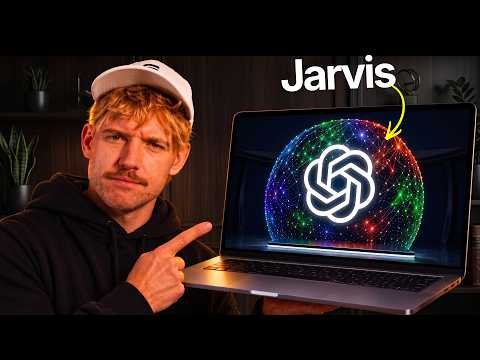
Meet Jarvis: How One Developer Built a Real AI Operating System Using GPT-6 Astra
What if your AI assistant didn't just answer questions ?" but actually knew you, remembered everything, and took action on your behalf? That's no longer a science fiction fantasy. Developer and content creator Jack Roberts has built exactly that: a fully functional, agentic AI operating system he calls Jarvis, powered by OpenAI's GPT-6 Astra. And the results, as he puts it, are nothing short of incredible.
Roberts recently walked viewers through a live demonstration of the system, revealing capabilities that go far beyond anything most people have seen from consumer AI tools. This isn't a chatbot with a polished interface slapped on top. It's a deeply integrated, memory-driven operating system that connects to your email, calendar, finances, social media, coding environments, and more ?" and then actually does things with that information.
"It actually connects to your entire world and has hands to do things for you ?" capabilities that you will not have seen before." ?" Jack Roberts
To help others replicate his build, Roberts has also released an agentic OS starter kit, making this one of the most accessible deep dives into next-generation AI infrastructure available today.
Why a Standard Chatbot Just Doesn't Cut It Anymore
Roberts is quick to draw a sharp distinction between what he's built and what most people think of when they hear "AI assistant." The problem with conventional tools, he argues, is that they exist in isolation. You ask a question, you get an answer, and nothing else happens. There's no memory, no context, and certainly no action taken on your behalf.
For an agentic OS to be genuinely useful, Roberts identifies three non-negotiable requirements. First, it must connect to your world ?" aggregating information from across your digital life including tools like Claude, Codex, ChatGPT, Gmail, Slack, Notion, and beyond. Second, it must organise all of that information into something coherent and easy to navigate. Third ?" and most critically ?" it must actually do things.
"It needs to be able to actually do things for you, not just be something that you could have done by yourself in ChatGPT." ?" Jack Roberts
That third pillar is what separates a genuinely agentic system from a sophisticated search interface. And it's where GPT-6 Astra, with its expanded context window and reasoning capabilities, changes the game entirely.
The Memory Core: Your AI's Long-Term Brain
At the heart of Roberts' Jarvis OS is what he calls the Memory Core ?" a dynamic, ever-evolving repository of everything the system knows about you. Pulling in data from ChatGPT conversation histories, Claude sessions, meeting notes, photos, and more, the Memory Core serves as the foundational intelligence layer of the entire operating system.
Crucially, this memory isn't static. New memories are added automatically in the background as you work. Have a conversation in Claude? It's captured. Receive an important email? It's logged. Attend a meeting recorded in Granola? It's available. The system runs completely locally on your computer, ensuring both speed and privacy.
During his demonstration, Roberts showed just how responsive this memory layer can be. By simply typing a preference ?" noting, for example, that his favourite colour is green and his favourite animal is an English Springer Spaniel ?" that information was immediately saved and retrievable in subsequent conversations, even across different AI model interfaces.
"You're in a meeting, you see an article you think is interesting. You can just drop it in here and literally click save to memory." ?" Jack Roberts
This "save to memory" functionality transforms the OS into something more akin to a persistent digital brain than a tool you pick up and put down. Everything you encounter, every insight you want to preserve, every meeting you attend ?" it all flows into one unified, queryable knowledge base.
Setting Up Your Digital Identity: Business and Life Profiles
One of the more thoughtful design decisions in Roberts' system is the onboarding experience. Rather than dumping users into a blank interface and expecting them to configure everything from scratch, the OS begins by building a comprehensive profile of who you are and what you're trying to achieve.
Roberts describes two core profile types: a life profile and a business profile. The life profile captures your personal priorities, habits, and focus areas. The business profile digs into your customers, your offerings, and your commercial goals. Together, these profiles give the system the context it needs to be genuinely useful rather than generically helpful.
The setup process itself is elegantly simple. You provide an initial prompt, and GPT-6 Astra interviews you ?" asking targeted questions to build out a rich, structured understanding of your world. The result is a deeply personalised context layer that informs every interaction you have with the system going forward.
"The most important thing on here is context." ?" Jack Roberts
Roberts is emphatic on this point. Without meaningful context, even the most powerful AI model is flying blind. The profile system ensures that Jarvis always has the background it needs to give responses and take actions that are genuinely relevant to your specific situation.
One-Click Integration: Connecting Your Entire Digital World
Perhaps the most visually impressive part of Roberts' demonstration is the integration hub ?" a clean, one-click interface that allows users to connect virtually every tool in their digital stack without writing a single line of integration code.
The system supports a remarkable breadth of connections out of the box. On the coding and AI side, users can link Codex, Claude, Hermes, and Open Router. For memory and notes, Granola, Notion, and Obsidian are all supported, along with photo libraries. Communication tools including Gmail, Outlook, and Slack can be brought in with a single click. Even social media profiles, YouTube channels, school platforms, and financial accounts can be connected to give the OS a complete picture of your life and work.
For anything not natively supported, Roberts points to Zapier as the connective tissue that fills the gaps.
"Almost any app that you want to connect to, you can almost guarantee that Zapier will give you access." ?" Jack Roberts
Roberts speaks from personal experience with the automation platform ?" he credits Zapier as a tool he used when building his very first tech startup. As a connection layer within the agentic OS, Zapier essentially makes the system infinitely extensible, allowing it to reach into virtually any application or workflow a user relies on.
Goal Tracking and the Daily Brief: Your AI-Powered Command Centre
Connecting to your world is only valuable if the system uses that information to help you move forward. Roberts has built robust goal-setting and progress-tracking functionality directly into Jarvis, turning it into something closer to an executive assistant than a search engine.
Users can define goals at multiple time horizons ?" daily, weekly, monthly, and quarterly ?" and the OS actively tracks progress against those targets using real data pulled from connected systems. The centrepiece of this functionality is the Daily Brief: a personalised, AI-generated summary delivered each morning that tells you exactly what to focus on, based on your goals, your calendar, your finances, and your recent activity.
The dashboard view brings all of this together in a single glance, showing key metrics, financial summaries, audience growth figures, and goal progress in one clean interface. While Roberts notes that the numbers shown during the demonstration are sample data, the architecture is fully functional and draws from real connected accounts in live use.
"Wherever you're at, the operating system is actually working for you and taking action." ?" Jack Roberts
This is the vision of agentic AI made tangible: not a passive tool that waits to be asked, but an active system that monitors your world and proactively surfaces what matters most.
Commanding Claude and Codex from Inside the OS
One of the more technically impressive features Roberts demonstrates is the ability to issue commands to Claude and Codex directly from within the Jarvis interface ?" without ever switching applications. During the walkthrough, he instructs Jarvis to open a new Codex session and ask it how to improve the OS itself, and the system executes the task seamlessly.
This kind of meta-capability ?" using one AI to orchestrate another ?" is emblematic of where the field is heading. Rather than toggling between half a dozen tools, users can work from a single command centre that delegates tasks to whichever AI model is best suited for the job at hand.
The model selection available within the chat interface underscores this flexibility. Users can choose between GPT-6 Astra, Claude, Hermes, Open Router, or even local models depending on their needs, privacy preferences, or the nature of the task. The OS acts as a universal front end, abstracting away the complexity of managing multiple AI subscriptions and interfaces.
Building Your Own: The Agentic OS Starter Kit
What makes Roberts' project particularly significant is his commitment to making it replicable. Rather than keeping the architecture proprietary, he has packaged his work into a downloadable starter kit ?" complete with the full agentic memory systems, onboarding flows, and setup guides ?" and made it available to his community.
The starter kit is designed with accessibility in mind. The entire setup is intended to feel like a one-click experience rather than a weeks-long technical project. Roberts is also committed to updating the kit continuously, so members of his community always have access to the latest improvements and integrations.
For those who want to go deeper, Roberts offers detailed guidance on building AI systems with both ChatGPT and Claude, giving builders the foundation they need to customise and extend the OS for their own specific needs and workflows.
"You can honestly build essentially anything you want to now with ChatGPT Astra." ?" Jack Roberts
Whether you're a solo entrepreneur looking to automate your daily workflows, a developer curious about agentic AI architecture, or simply someone who wants their AI tools to finally work together in a meaningful way, Roberts' Jarvis OS represents one of the most compelling real-world demonstrations of what's now possible. The age of the AI operating system, it seems, has quietly arrived ?" and it's more capable than most of us imagined.