Featured Product
Split Shot Fishing Weights Assortment
Split shot sinkers used for drift fishing steelhead and salmon on the Salmon River
"How many split shots do you have on? Same. Where do you have them at?"
Into the Wild Waters: 48 Hours Chasing Steelhead on New York's Legendary Salmon River
Few fisheries on the East Coast carry the same mythic weight as New York's Salmon River. Tucked into the Oswego County landscape of upstate New York, this stretch of water draws fly fishermen, spin anglers, and weekend warriors from across the country every autumn, all chasing the same electric dream: a fresh-run steelhead surging upstream with the kind of power that makes your knees buckle. The HighTide Co. crew arrived at the Douglaston Salmon Run (DSR) with two days, fly rods, and an appetite for punishment — and what unfolded over those 48 hours was equal parts chaos, humility, and pure, unfiltered triumph.
Day One: Earning It the Hard Way
The alarm went off before dawn. The plan was simple — get ahead of the crowds by pushing downriver toward Lake Ontario, intercepting fresh steelhead before they had time to wise up or scatter. With a fly rod loaded up and the sun just coming up, the crew set off through the woods in search of productive water.
"We are going that way, which I think is more towards the lake, hopefully to find a lot of those fresh fish coming up," said one of the anglers, peering downriver into the grey morning light. "The run hasn't really started in full force yet, so if we can catch them early, that's what we're going to do."
The optimism was warranted. Even before the first cast was made, it was clear the river was alive. King salmon rolled in the pools, their dark backs slicing the surface. Dozens of fish stacked in the deeper holes, their fins visible from the bank — a sight that sent adrenaline surging through the entire crew.
"There's like 20, bro." The words hung in the air for a moment before the rods went up and the chaos began.
But the Salmon River has a way of humbling even experienced anglers, and day one delivered its lessons with brutal efficiency. Fish were hooked and lost in rapid succession — a brown trout here, a king salmon there, a massive steelhead that made one searing run before the line went slack. After five or six lost fish, the crew had just a single Atlantic salmon, the prime target of the trip, to show for the effort.
The Atlantic Salmon: A Rare Prize
When Iggy finally brought his Atlantic salmon to hand after a string of heartbreaking losses, the relief was palpable. "What a rare sight," the crew said. The crew gathered around to admire the catch, taking note of the fly still lodged in the corner of its jaw.
"I just want to get a picture with the fly in his mouth because it looks so funny," Iggy said, laughing as he cradled the fish. "Look at his jaws — totally messed up, dude."
The fish was quickly released, sliding back into the current with a powerful kick. It was, by any measure, a rare and meaningful catch — the kind of moment that makes the sting of a dozen lost fish feel entirely worthwhile. For a crew that had named Atlantic salmon the prime species they wanted on this trip, checking that box felt like a genuine victory.
Fly Selection: Finding the Right Pattern
Between hook-ups, the conversation inevitably turned to flies. The day had started with a pretty small orange egg sack imitation, but as the day wore on and fish continued to elude the net, it was time to experiment.
Spread out on a dry patch of bank, a box of patterns offered options from a tiny multicolor egg pattern to nuke eggs in light and dark colors. "I don't think I ever used these before," admitted one angler about the tiny multicolor egg pattern after losing his fly. "Really like all these light colors. Light blue. I'll probably try this green next. Maybe these nuke eggs. I like this darker one as well."
On day two he laid out the plan: orange, yellow, white, cream, and light blue patterns for midday, and a different pattern for the evening. For tippet, he said you usually want something like six or seven pound, and even 5 lb is good.
When the River Wins: On Falls, Swims, and Snapped Lines
No honest account of a day on the Salmon River would be complete without acknowledging the river's capacity to make fools of even the most sure-footed anglers. Day one also brought an unexpected swimming lesson when one crew member stepped onto a slick rock, lost his footing, and went straight over backwards into the current — rod, reel, and dignity fully submerged.
"Stepped on a slippery rock and just went right backwards. We went for a little swim. Water felt nice, but all we can do is get back out there."
It was the kind of moment that defines a fishing trip — equal parts embarrassing and endearing. Wet gear was wrung out, laughs were shared, and the angler was back in position within minutes. The fish, as always, cared nothing for human misfortune.
As the afternoon wore on, a fellow angler named Gabe came over, offering to work the net while the crew battled a particularly stubborn steelhead. Despite the fish making one final, desperate run just as it neared the bank — snapping the tippet and disappearing back into the current — the gesture was deeply appreciated.
"That last run just got me, man," came the rueful admission afterward. "He was so tired and he just made one last run, and that was it. Unreal."
The Dink That Saved the Day
Late afternoon on day one felt like a turning point. After a long string of lost fish, a small steelhead finally stayed buttoned.
"Finally. Holy crap. And it's a dink," came the call, equal parts relief and laughter. "Look at that beautiful dink rat steelhead. But I am so happy. This is the first fish we bagged."
The fish went back with a splash, and the mood on the bank lifted immediately. One for probably 15, by his count. The crew lost one more fish during the sunset bite, then walked out to get something to eat and plan day two at their rental, the Double Eagle Lodge. It sits between Pulaski and Altmar, with the Sportsman's Pool right down the road and a private stretch of river in the backyard.
Day Two: A New Strategy, A Changed River
Morning brought a tactical overhaul. After watching some videos on strategy, and after hooking five fish in about 30 minutes the evening before, the crew decided to avoid the calm water the king salmon held in and fish the faster, broken water instead.
"We're going to fish mainly the rapid water today," one angler explained as the group geared up in the predawn quiet. "Usually the salmon will sit in the calmer water and not go so much in that fast-moving break. So we're going to go up in there for some steelhead hopefully."
The adjustment paid off. Iggy landed the first fish of the day, and the net man, who said he hadn't missed a fish with the net yet on the trip, kept it that way.
"Four for four on the net jobs," came the triumphant call after yet another fish slid cleanly into the mesh. It was the kind of quiet competence that only comes from two days of hard-earned experience on the same water.
Mayhem at the Money Spot
By midday, the crew had located what can only be described as a money spot — a section of river where steelhead were stacked in numbers that made every cast feel electric. When a double hookup materialized — Joe tight to a fish heading downstream while Saki battled one heading in the opposite direction — the scene on the bank descended into beautiful, laughing chaos.
"This is mayhem," someone called out, voice pitched high with excitement. "Saki's getting murdered over there right now by that steelhead. Joe's getting taken down the river."
They also ran into fellow YouTubers Mike and Mason of CruzN4Adv (Cruisin' for Adventure). By the time Iggy hooked a king on a red fly, the crew counted it as about the seventh fish of the day, a complete reversal of the day before.
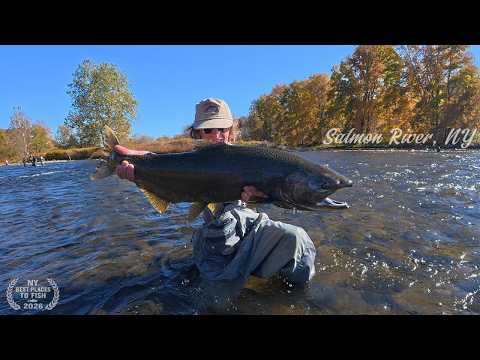
The highlight came when one angler connected with what he believed was a personal best steelhead. "This is probably my PB steelhead, actually," he said quietly, holding the fish horizontal in the shallows as it gathered its strength. "I don't even know how big it is. Wow. Awesome, dude. That was a sick fish."
Four Species in Forty-Eight Hours
As the afternoon pushed toward evening, the Salmon River delivered one final, unexpected gift. A brown trout came to hand, pushing the crew's species count to four over the course of the trip: Atlantic salmon, king salmon, steelhead, and brown trout. The only one left was a coho, and the crew wasn't sure any were still in the river.
"Four species on the trip, dude," came the disbelieving laugh. "Atlantic salmon, king salmon, steelhead, and brown trout. Let's go."
The fish, predictably, chose exactly that moment to bolt from the angler's grip before a proper photograph could be taken. The laughter that followed said everything about the spirit of the two days — nothing on the Salmon River comes easy, and that is entirely the point.
What the Salmon River Demands — and Gives Back
The drive home, stomachs full and gear still damp, offered time to reflect on what forty-eight hours on one of America's most demanding fall fisheries actually means. The Salmon River is not a place for the faint-hearted or the easily discouraged. The crowds are real, the confrontations are real, the lost fish and snapped tippets and unexpected swims are all very real. The smell of decomposing salmon, as the crew noted with considerable understatement, is genuinely extraordinary.
But underneath all of it runs something irreplaceable — a wild, cold, fish-filled river that rewards patience, adaptability, and a willingness to get back up after the tenth heartbreaking loss of the day. The steelhead that finally comes to hand after a string of failures feels like nothing else in freshwater fishing. It is earned in a way that comfortable fishing rarely is.
"Probably the best trip we have ever had out here by far," reflected one angler as the crew wrapped up. "And it just makes me so much more excited to come back again."
On a river as alive and as humbling as the Salmon, that is the highest possible compliment — and the surest sign that the fish have already won.
Based on a video by HighTide Co. on YouTube.
