Featured Product
Harbinger 21900 Real Leather Pro Lifting Straps
Lifting straps to improve grip during deadlifts and other pulling movements
"The trainer repeatedly recommends using straps for Romanian deadlifts, step-ups, and lateral raises so grip strength doesn't limit the target muscle"
The Case for Minimalist Training: Why Less Can Be More
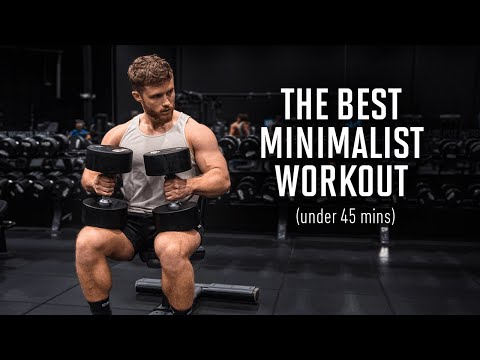
In a fitness culture obsessed with volume, complexity, and marathon gym sessions, the idea of getting a genuinely effective workout in under 45 minutes feels almost rebellious. Yet that's precisely what strength coach and natural bodybuilder Jeff Nippard argues is not only possible, but for many people, optimal. His science-based minimalist workout plan distills years of research and practical experience into a lean, efficient two-day-per-week full-body program ?" one that can be scaled up to five days without losing its essential character.
The philosophy here isn't about cutting corners. It's about cutting waste. Every exercise choice, every rep range, every technique cue has a reason behind it ?" and understanding those reasons is what separates a truly minimalist program from one that's simply underprepared.
Before You Begin: The Warm-Up
Nippard keeps the warm-up deliberately brief but purposeful. Two to three minutes of brisk walking on the treadmill followed by a handful of dynamic stretches ?" a few arm swings, a few leg swings ?" is all that's required before diving into the first working set. This isn't laziness; it's efficiency. The goal is to elevate the heart rate, mobilize the joints, and prepare the nervous system without pre-fatiguing the muscles you're about to train.
The minimalist ethos begins here: do what's necessary, skip what isn't.
Mentioned in This Article
CAP Barbell Rubber-Coated Hex Dumbbells
Hex dumbbells used for flat dumbbell press, Romanian deadlifts, and step-ups
Full Body Day One: Building the Foundation
Flat Dumbbell Press ?" Strength and Size in Two Sets
The first working exercise is two sets of flat dumbbell press: a heavy set of four to six reps followed by a lighter back-off set of eight to ten. The structure is deliberate ?" a strength-focused set first, then a hypertrophy-focused set. But the choice of dumbbells over a barbell is equally intentional.
"Dumbbells are generally more time efficient because you don't need to load and unload any plates, which does chew up some time. And second, dumbbells allow for a greater range of motion than the barbell."
On a fuller program, a barbell's range-of-motion limitation can be compensated for by adding a stretch-focused accessory like a cable fly. But in a minimalist context, where the exercise count is deliberately low, it makes far more sense to select a pressing movement that already provides a meaningful stretch on the pectoral muscles. The dumbbell press and the dip are the two best candidates.
Technique matters as much as exercise selection. Nippard recommends lowering the dumbbells with the elbows tucked at roughly 30 to 45 degrees when viewed from above, then allowing a natural elbow flare on the press. For anyone experiencing shoulder discomfort during that flare, keeping the elbows tucked throughout the entire movement is a perfectly valid alternative.
Dumbbell Romanian Deadlift ?" Loading the Posterior Chain
Next comes two sets of dumbbell Romanian deadlifts for eight to ten reps per set, targeting the hamstrings and glutes. Again, dumbbells are favored over a barbell for time efficiency, though the biomechanics remain identical regardless of implement.
The coaching cue Nippard returns to repeatedly is to focus on hip displacement rather than weight displacement. Push the hips back, let the dumbbells travel straight down in a natural line, and reverse the motion once a deep hamstring stretch is felt ?" without allowing the lower back to round. Maintaining a smooth, continuous cadence without fully locking out at the top keeps constant tension on the hamstrings. Those who want to emphasize the glutes slightly more can choose to lock the hips and squeeze at the top of each rep.
Lifting straps are strongly recommended here. Grip strength is a common limiting factor on RDLs, and on a program where every set is precious, you don't want forearm fatigue cutting a hamstring set short.
Two-Grip Lat Pulldown ?" One Machine, Two Angles
The lat pulldown earns its place in a minimalist program by offering two distinct training stimuli within two sets, simply by changing grip position. The first set uses an overhand, mid-width grip to target the mid-back and lats. The second set switches to an underhand close grip, shifting more emphasis onto the biceps while hitting the lats from a slightly different angle.
After the second set, the weight is stripped back and a set of overhead curls is performed ?" a quick, effective way to ensure the high-threshold bicep fibers experience meaningful tension without requiring a dedicated bicep exercise slot earlier in the workout.
Dumbbell Step-Up ?" Single-Leg Precision
The step-up serves as the primary quad and glute movement of the day, performed for one working set of eight to ten reps per leg. In a minimalist context, the significance of a single working set cannot be overstated ?" execution must be close to perfect, because there is no second chance to accumulate the necessary stimulus.
"Because we're often only doing one single set for some exercises, it's very important that we execute that set as perfectly as possible."
The key technical point is ensuring the front leg carries the load. The trailing leg exists purely for balance ?" any pushing off with it is a form of cheating that bleeds stimulus away from the working muscles. Working one leg at a time, completing all reps on one side before switching, prevents the loss of tension that occurs when alternating legs rep by rep. And as with the RDLs, straps are recommended to keep grip from becoming the limiting factor.
Overhead Cable Tricep Extension ?" The Science of Stretch
For tricep isolation, the overhead cable extension is chosen over the more commonly seen pressdown ?" and the reasoning is grounded in both anatomy and emerging research. Since the flat dumbbell press already trains the triceps in a relatively neutral shoulder position, a pressdown would create significant overlap. The overhead extension, by contrast, places the triceps under load in a lengthened position, creating a meaningful complement rather than redundancy.
The research support is notable. A 2022 study by Maeo and colleagues found that overhead tricep extensions produced approximately 40 percent more hypertrophy than pressdowns, even when total training volume was matched. Nippard is careful to temper the finding:
"I wouldn't put too much stock in a single study like this, but if you are limited on time and can only fit in one tricep isolation movement, I would favor an overhead tricep extension over pressdowns."
The set structure involves reaching failure, then dropping the weight by 30 to 40 percent and going to failure again ?" a drop set that extends the effective stimulus without adding a full additional set to the session's time cost.
Machine Lateral Raise ?" Isolating the Side Delts
Shoulder width is built primarily through the lateral deltoid, and the machine lateral raise is the chosen tool here ?" specifically because machines offer consistent tension throughout the range of motion in a way that free weights often cannot. Straps are again recommended, this time to eliminate the thumb and grip from acting as limiting factors during the sweep.
A drop set follows failure, with the same 30 to 40 percent reduction. The total volume remains modest, but the intensity is high ?" which, for a muscle group like the side delts, is precisely the right combination.
Horizontal Toe Press ?" Calf Work, Done Properly
Day one closes with one set of horizontal toe presses on a leg press machine ?" essentially calf raises performed with the leg extended. With the upper body supported by the machine, mental focus can be directed entirely toward the calves, improving the mind-muscle connection. A one-second pause at the bottom of each rep and a full squeeze at the top ensure full range of motion. A drop set follows, with the caution to resist letting form deteriorate as fatigue accumulates ?" bouncing through reps is the enemy of calf development.
Full Body Day Two: Intelligent Variation
Hack Squat ?" Machine Efficiency for Quad Dominance
Day two opens with the hack squat, following the same two-set structure as the dumbbell press on day one: one heavy set of four to six reps, one lighter back-off set of eight to ten. The machine choice is strategic. Free-weight squats demand extensive warm-up time ?" sometimes 20 to 30 minutes of progressively heavier ramp-up sets before true working weight is reached. The hack squat machine compresses that preparation into two or three quick sets.
The heavy set targets an RPE of nine ?" one rep shy of failure ?" with focus placed on driving through the heels while maintaining steady contact with the shoulder pads. After three minutes of rest, the back-off set shifts the focus from power output to feel: controlling the negative, sensing the quads working, pursuing the mind-muscle connection. Full depth is encouraged on both sets, with the knees tracking naturally over and past the toes ?" a movement pattern that is biomechanically safe despite its persistent, undeserved reputation.
Antagonistic Superset: High Incline Smith Press and T-Bar Row
The most time-efficient section of either workout comes next: an antagonistic superset pairing a pressing movement with a pulling movement. When opposing muscle groups are trained back to back, one can recover while the other works ?" effectively halving the rest time without compromising the quality of either exercise.
The chosen pairing is a high incline Smith machine press at 45 to 60 degrees ?" deliberately angled to bring the shoulders into the movement alongside the chest and triceps ?" supersetted with a T-bar row targeting the mid-traps, lats, rear delts, and biceps. The incline angle serves a specific minimalist purpose: rather than training horizontal pressing and vertical pressing as separate exercises, the high incline splits the difference, stimulating both the pecs and the anterior deltoids effectively in a single pattern.
A closer grip on the Smith press extends the triceps' range of motion while also shifting emphasis toward the upper chest ?" a region that tends to be underdeveloped in most lifters. For the rows, alternating between a wider grip on the first set and a closer grip on the second ensures the back is hit from two slightly different angles, maximizing the return on just two sets. And though it's a superset, a short 30-to-60-second rest between exercises is recommended rather than moving directly from one to the next.
Seated Hamstring Curl ?" Research-Backed Variation
For hamstring isolation, the seated leg curl is chosen over the lying variation ?" and again, the decision is backed by published research. A 2020 study demonstrated greater hamstring hypertrophy with seated leg curls over a 12-week training period, a finding attributed to the greater degree of muscle stretch achieved when the hip is flexed during the curl. To amplify this effect further, Nippard recommends leaning forward over the machine throughout each set.
One all-out set to failure, followed by a drop set, constitutes the full hamstring isolation volume for day two. It may look sparse on paper, but combined with the RDLs from day one and the hip hinge mechanics built into the hack squat, the posterior chain receives comprehensive stimulus across the week.
EZ Bar Bicep Curl ?" Technical Excellence Under Fatigue
Bicep work on day two centers on a single high-quality set of EZ bar curls for 12 to 15 reps, followed by myo-rep clusters rather than a traditional drop set. The technique cues reflect a deep understanding of where most people lose their bicep curls to momentum and forearm involvement: curl out and up rather than simply up, drive through the pinky finger to cue supination, keep a loose grip on the bar to prevent the forearms from dominating, and think about squeezing the bicep to initiate the movement rather than simply pulling the weight.
After reaching failure, instead of reducing the weight, the myo-rep method is applied: rest three to four seconds, perform four reps, rest again, perform four more, and repeat until four reps can no longer be completed. The rationale is rooted in hypertrophy science:
"It isn't until near the very end of a set that reps become maximally hypertrophic. So by doing these myo-rep mini sets where the muscle is already very close to failure, you're essentially cutting out any of those early low-tension reps and jumping straight to the more effective stuff."
Cable Crunches ?" A Strong Finish for the Core
Day two concludes with cable crunches ?" one set of 12 to 15 reps followed by a double drop set. Kneeling with the rope locked overhead, the movement involves crunching the entire spine down and allowing the lower back to round fully, maximizing the contraction through the abdominals. The double drop set ?" two successive weight reductions to failure ?" ensures the core is thoroughly worked despite the modest exercise count.
Mentioned in This Article
Rogue Fitness EZ Curl Bar
EZ curl bar used for bicep curls with reduced wrist strain
Scaling Up: From Two Days to Five
The two-day full-body structure forms the spine of the program, but Nippard has designed it to scale gracefully for those with more time to train.
For a three-day week, the first full-body session remains intact while the second is divided into a dedicated upper-body day and a dedicated lower-body day. Extra sets or exercises can be added to address individual weak points on those split days.
For a four-day week, both full-body sessions are split into upper and lower components, producing a classic upper-lower-upper-lower structure. Volume can be added where it's warranted without disrupting the core principles.
For a five-day week, the framework expands into an upper-lower-push-pull-legs arrangement ?" one of the most well-regarded training splits in evidence-based fitness ?" while retaining the minimalist philosophy of each session staying focused and purposeful.
The Minimalist Principle: Every Set Earns Its Place
What makes this program genuinely useful isn't any single exercise or technique ?" it's the underlying discipline of justification. Every choice has a reason: dumbbells for range of motion and efficiency, machines for reduced warm-up time, drop sets and myo-reps for extending stimulus without extending session length, antagonistic supersets for training density. Nothing is included out of habit, and nothing is excluded without cause.
In an era of information overload and gym-floor paralysis, that kind of clear-eyed prioritization is perhaps the most valuable training principle of all. Whether you have two days a week or five, the question to ask of every exercise is the same one Nippard implicitly asks throughout this program: does this earn its place? If the answer is yes, keep it. If not, cut it ?" and use the time you've saved on rest, recovery, and everything outside the gym that makes the training matter in the first place.
Mentioned in This Article
Yes4All Wooden Plyo Box Step Up Box
Sturdy step-up box for dumbbell step-up exercises targeting quads and glutes
