Featured Product
CAP Barbell Olympic Bar
Standard Olympic barbell for compound lifts like Barbell Bench Press, Barbell Overhead Press, Barbell Row, and Deadlift
"Workout A and B both feature barbell squat, barbell hip thrust, barbell bench press, deadlift, overhead press, and barbell row"
The Case for Total Body Training: Why One Workout Isn't Enough
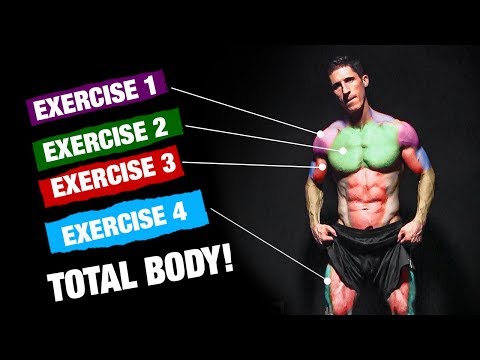
In an era of split routines, dedicated arm days, and single-muscle obsession, total body training has quietly staged a comeback ?" and for good reason. Jeff Cavaliere, physical therapist and founder of ATHLEAN-X, has built a reputation for cutting through fitness noise with science-backed programming. His latest contribution to the conversation is a deceptively simple but deeply considered framework: two complementary total body workouts designed to be alternated across a Monday, Wednesday, Friday schedule.
The challenge, as Cavaliere freely admits, is significant. "It's hard to declare perfection in a single workout when we're trying to hit our entire body," he says. But rather than shying away from that difficulty, he leans into it ?" delivering not one but two carefully structured sessions, each designed to complement the other while standing alone as a complete training stimulus.
What makes this approach worth your attention isn't just the exercise selection. It's the underlying philosophy that drives every programming decision ?" a movement-first mindset that prioritizes how the human body actually functions over how a muscle chart is drawn.
Think in Movements, Not Muscles
Before a single set is prescribed, Cavaliere reframes the entire conversation. Forget mentally mapping exercises onto individual muscle groups. Instead, he argues, think about movement patterns ?" and train those. "If we can train the movements in a particular workout," he explains, "then we can incorporate the muscles that achieve those movements."
This isn't just semantic wordplay. It's a practical shift that simplifies programming and ensures no fundamental athletic capacity gets left behind. Every workout in this framework is built around seven core movement categories:
The Squat Pattern ?" foundational lower body strength through knee-dominant movement. The Lunge Pattern ?" unilateral lower body work that demands balance, stability, and hip mobility. The Hinge ?" hip-driven posterior chain development, the most undertrained movement pattern in most gym-goers' repertoires. The Push ?" horizontal or vertical pressing to develop the chest, shoulders, and triceps. The Pull ?" rowing and pulling movements to build a strong, balanced back. The Carry ?" a loaded locomotion pattern that builds grip, core stability, and real-world strength. And finally, the Corrective ?" a targeted exercise designed to address postural imbalances and injury prevention before problems arise.
Together, these seven categories form a complete athletic framework ?" one that mirrors the demands of real life and sport far more closely than a traditional body-part split ever could.
Mentioned in This Article
Rogue Fitness Weight Plates Bumper Plates
Olympic weight plates for loading barbells for compound lifts
Workout A: Building the Foundation
The first session is where most people should begin, particularly those new to total body training or those simply looking to experience what a well-designed full-body session feels like. Each exercise is chosen with deliberate intent, and each set-and-rep scheme reflects a specific physiological goal.
The Warmup: Multidirectional Lunge
Before any load is lifted, the body needs to move ?" and the multidirectional lunge is Cavaliere's warmup of choice. It's a deceptively versatile tool that mobilizes the hips across all three planes of movement simultaneously: forward in the sagittal plane, laterally in the frontal plane, and rotationally in the transverse plane.
"It gets us to move in multiple directions and helps us mobilize our hips in all three planes of movement," Cavaliere notes, adding that it was a staple in his training sessions with NFL wide receiver Antonio Brown. "His entire dynamic warmup consists of different variations of the lunge. It's that effective for getting him ready to do what he has to do."
The prescription is two to three rounds of seven repetitions in each direction ?" a low-cost, high-return investment that takes only minutes but sets the tone for everything that follows.
The Squat: Barbell Back Squat ?" 3 Sets of 5
With the body primed and the hips mobile, it's time for the primary lower body strength movement. Cavaliere selects the barbell back squat ?" no surprise there ?" but the set-and-rep scheme deserves attention. Rather than the more common five sets of five, the total body context demands a slight reduction in volume: three sets of five.
This isn't a concession to laziness. It's an acknowledgment that additional movement patterns still need to be addressed within the same session. The goal remains progressive overload: when all three sets of five are completed cleanly at a given weight, that weight goes up. The principle is simple, the execution is consistent, and the results follow accordingly.
The Hinge: Barbell Hip Thrust ?" 3?"4 Sets of 10?"12
One of the most overlooked exercises in strength training gets a prominent place in Workout A. The barbell hip thrust isolates the hinge pattern in its purest form ?" and forces honest engagement from the glutes, a muscle group that Cavaliere argues most people have effectively trained themselves to neglect.
"People don't get this right and we suffer from what we call 'glute amnesia' ?" never driving from the appropriate muscles to drive a hinge."
The solution is to drop the ego, reduce the load, and extend the rep range to ten to twelve repetitions across three to four sets. The purpose isn't to simply move weight ?" it's to re-establish a neuromuscular connection with the glutes and teach the body to drive the hinge correctly. That distinction matters enormously, both for performance and long-term hip health.
The Push: Barbell Bench Press ?" 3 Sets of 5
The upper body foundational push comes in the form of the barbell bench press ?" one of the few exercises whose status as a cornerstone lift remains largely uncontested. Three sets of five keeps the volume manageable within the total body context while preserving the progressive overload stimulus that drives long-term strength gains.
For those who feel insufficiently warmed up at this point in the session, a few lighter preparatory sets are encouraged. The priority, as always, is quality of movement over the weight on the bar.
The Pull: Weighted Chin-Up ?" 3 Sets of 6?"10
To balance the horizontal push with a vertical pull, Cavaliere turns to the weighted chin-up. The loading parameters here are worth noting ?" he deliberately steps back from the heavy, low-rep territory that might seem appropriate for such a compound movement.
"I don't go all the way down to the three-to-five rep range because I find that people really cheat those reps and they don't initiate with the muscles they need to," he explains. By targeting six to ten repetitions, lifters are encouraged to use a weight that demands proper scapular depression and lat engagement from the very first rep ?" qualities that disappear quickly when the load climbs too high.
The Carry: Farmer's Walk ?" Half Bodyweight Per Hand, 50 Steps
The carry is perhaps the most underrepresented movement pattern in conventional gym programming ?" and it's one Cavaliere is unequivocal about including. The prescription is straightforward: half your bodyweight in each hand, walked for fifty steps. The fifty-step standard is chosen deliberately over a distance measurement, making it equally accessible whether you're training in a commercial gym or a studio apartment.
The benefits extend well beyond the obvious grip challenge. "You're building grip sustainability ?" not just overall force output, but sustainability of force output, which is a critical component that benefits all our bigger lifts very well," Cavaliere emphasizes. That sustained gripping demand has downstream effects on the deadlift, the row, the chin-up ?" virtually every compound movement that matters.
The Corrective: Face Pull ?" 2 Sets of 12
Workout A closes with what has become something of a signature Cavaliere prescription: the face pull. Two sets of twelve reps, performed with the kind of deliberate focus that transforms a finishing exercise into something genuinely restorative.
His mental framing is instructive: think of each set not as twelve reps, but as twelve individual sets of one. The result is twenty-four high-quality repetitions targeting the external rotators, rear deltoids, and mid-traps ?" the postural muscles that modern life systematically weakens and that heavy pressing work consistently overpowers without this kind of intentional counterbalance.
Workout B: Filling in the Gaps
If Workout A is the foundation, Workout B is the complement ?" designed to address what A leaves unfinished while introducing enough variation to keep adaptation running. The structure mirrors its counterpart closely, but the exercise selection shifts in meaningful ways that ensure, across a full training week, no movement pattern is neglected and no muscle is perpetually either overloaded or underserved.
The Warmup: 3D Lunge (Repeated)
The multidirectional lunge returns as the warmup for Workout B ?" and Cavaliere makes no apology for the repetition. Its value as a total body primer is consistent regardless of what follows, and its hip mobilization benefits remain just as relevant when the session ahead is dominated by deadlifts rather than squats.
The Hinge: Conventional Deadlift ?" 3 Sets of 5
Where Workout A treats the hinge as a secondary pattern addressed through hip thrusts, Workout B elevates it to primary status. The conventional deadlift takes the anchor position ?" the most neurologically demanding exercise in the session ?" and receives the same three-sets-of-five progressive overload treatment applied to the squat in Workout A.
The neurological cost of the deadlift is an explicit consideration in the programming decisions that follow. Everything downstream in Workout B is calibrated with the awareness that the central nervous system has already been substantially taxed before the second exercise begins.
The Squat/Lunge: Reverse Barbell Lunge (or Squat) ?" 10 Reps
Following the deadlift, the lower body component of Workout B offers a choice ?" but Cavaliere has a clear preference. The reverse barbell lunge is his recommended option, giving lifters an opportunity to load a pattern they rarely take seriously. For those who insist on squatting, the instruction is equally clear: reduce the load and treat this as a de-load from the squat rather than a second heavy lower body strength movement.
Either way, the ten-rep range is maintained ?" higher than the deadlift scheme, accommodating both the residual fatigue from that foundational lift and the need for technical precision in a unilateral movement.
The Push: Overhead Press ?" 3 Sets of 5
Workout A's horizontal push gives way to a vertical one. The overhead press ?" barbell or dumbbell ?" demands shoulder stability, thoracic extension, and core bracing in ways the bench press simply doesn't replicate. It also tends to plateau earlier and more stubbornly than the bench press, which makes the commitment to progressive overload here both more challenging and more rewarding.
The programming logic remains consistent: three sets of five, with the expectation of incremental load increases over time. The pattern changes; the principle doesn't.
The Pull: Barbell Row ?" 3 Sets of 10?"12
The row replaces the chin-up as the pulling movement in Workout B, and once again the rep range sits higher than might be expected for a barbell compound movement. Cavaliere's reasoning is twofold. First, with the deadlift already in the session, the lower back has absorbed significant stress ?" heaving a barbell row at heavy loads risks compounding that fatigue in ways that compromise both form and safety. Second, back engagement and lat activation are simply more accessible at moderate weights where the lifter can focus on the quality of the contraction rather than surviving the load.
"Getting back engagement and lat engagement is a little bit easier when you lighten the weight and focus on how you're lifting the weight."
The Carry: Overhead Carry ?" Quarter Bodyweight Per Hand, 50 Steps
The farmer's walk of Workout A transforms into something more demanding in Workout B: an overhead carry, with arms extended directly above the head. The load drops substantially ?" a quarter of bodyweight per hand rather than half ?" but the challenge increases dramatically. Maintaining vertical arm position while walking activates the mid and lower trapezius to a degree that most lifters have never experienced.
"You're going to feel a lot of challenges to keeping your arms as upright and straight as possible," Cavaliere notes, "and you're going to feel that mid and lower trap area really work overtime." That postural demand makes the overhead carry a uniquely valuable complement to the session's pressing work ?" training the very muscles responsible for shoulder health under a functional, dynamic load.
The Corrective: Face Pull or Alternative
Workout B concludes with another corrective ?" and while the face pull remains an endorsed choice, Cavaliere opens the door to alternatives. The hip band mini ladder addresses lateral hip stability. Band pull-aparts target the posterior shoulder and mid-back. Basic external rotation exercises serve the rotator cuff. The specific movement matters less than the commitment to including something ?" a deliberate, focused effort to address the structural weaknesses that accumulate over years of training and modern sedentary living.
Mentioned in This Article
Synergee Dip Belt Weighted Belt for Pull-ups
Weighted belt used to add resistance to chin-ups
Programming the Perfect Week
Used together on a Monday, Wednesday, Friday schedule, Workouts A and B create a training week that is simultaneously comprehensive and sustainable. The alternation ensures that no single pattern is hit with the same stimulus two sessions in a row, while the consistent return to foundational movements allows for meaningful progress tracking and progressive overload over time.
In a three-session week, the pattern naturally alternates: A, B, A one week; B, A, B the next. Over a month of training, each workout appears roughly the same number of times ?" a balanced exposure that prevents the asymmetries that so often develop when lifters unconsciously favor certain sessions over others.
For those who want to go deeper, Cavaliere points to his Total BeaXt program ?" a ninety-day, day-by-day plan built around total body training principles, incorporating athletic conditioning drills and a more extensive corrective exercise library. But as a starting point, or as a standalone framework for lifters who want structure without complexity, these two workouts represent something genuinely useful: a principled, movement-based approach to training the whole body ?" intelligently, efficiently, and with an eye toward staying healthy enough to keep doing it for the long haul.
The Bottom Line
What distinguishes this framework from the thousands of total body workout templates that populate fitness websites isn't any single exercise ?" it's the coherence of the thinking behind every decision. Set and rep schemes reflect the neurological demands of individual exercises. Volume is deliberately managed across the session. Corrective work isn't an afterthought; it's a non-negotiable component. And the carry ?" so often dismissed as a strongman novelty ?" earns its place as a functional training tool with real-world and performance implications.
Total body training done well isn't simply a matter of touching every muscle group in a single session. It's about understanding how movement patterns interact, how fatigue accumulates, and how to build a workout that leaves the body stronger, more resilient, and better prepared ?" not just for the next session, but for the demands of an athletic life.
These two workouts, used consistently and progressively, do exactly that.
Mentioned in This Article
Yes4All Adjustable Kettlebells Dumbbells for Farmer Carry
Heavy dumbbells used for farmer's carry exercises

